Mab C9nvicted of Child Molestation Under Charges Again
Tickling children is ane of those customary kinds of play that is handed down from generation to generation through our families. It is rarely questioned, but deserves to be thought about more than carefully, as it's a course of play that tin can, despite practiced intentions, hurt a child.

To put tickling in a broader framework, it's one of the ways to play that puts people in touch with each other. It too is a dependable way to go lots of laughter rolling. And so tickling looks, on the surface, like a kind of play that children enjoy, and that is good for them. And indeed, some children enquire their parents for tickling games. We are glad to exist asked—it feels great to have an instant way to laugh and be playful together.
But in my many years of listening to adults talk about the emotional challenges of their lives as children, tickling comes up again and over again every bit an experience that has been hurtful. I've listened to a number of adults who can't relax when others are in shut proximity to them. They can't sleep shut to a trusted partner, for example, or are internally on guard whatsoever time there'south more than casual touching between them and someone they honey.
When asked what they are agape of, their memories get straight to times when they were amused as children, and couldn't get the tickler to stop.
The Foundations of Healthy Play
I don't think that nearly tickling in families is pursued to the level of abuse, merely I do think that tickling can be replaced with healthier options. In healthy play, these footing rules are commonly operating. These guidelines insure the fun. They make play an intelligence-edifice activeness.
- Each child is respected.
- Each child has a way to succeed.
- Each child's contributions are best-selling.
- Each child knows she is safe from criticism and belittlement.
- Each child can say what she thinks and wants. Her ideas may not be workable, and limits may need to be set, just the thoughts are welcome as a worthy contribution.
- No child is coerced into a powerless or subservient role in the guise of play.
- An adult is present or nearby, to insure that the play stays prophylactic and inclusive.
- To promote laughter, the adults in the situation play the less powerful part, leaving the role of "the swift, the strong, the smart and the informed" to the children.
Where Tickling Falls Short
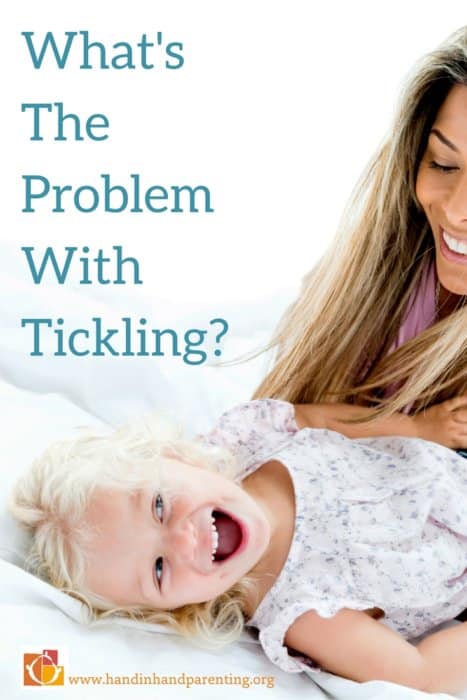 The main matter that makes tickling problematic is that children may not exist able to say when they want it to stop.
Laughter is an automated response to beingness touched past a tickler—it'south not a response that the kid can opt out of. This puts the tickler in accuse of how much or how long the kid laughs. Nigh of usa remember unpleasant or frightening times when we wanted a tickler to stop, merely were laughing then hard we couldn't say it, or worse, we said, "Cease!"or tried to escape, and the tickler connected.
Nosotros adults don't read children'southward minds, only we ofttimes imagine that we tin can. So nosotros ordinarily think we're enlightened of what's too much tickling and when to stop. Merely it is possible to trap our children without knowing information technology.
We Want to Play and Be Close
Parents and children crave times together when at that place's lots of costless-flowing laughter and playful contact. It'southso good for us to play,and then good for us to be in impact with each other. Nosotros parents become attached to tickling because it seems to exist a handy shortcut to laughter. We long to know that our children are happy and love the states, and tickling becomes our shortcut to this reassurance.
Rather than forcing laughter in this fashion, we can build our children's confidence if we will become down on the floor and invite them to be in playful physical contact with us. If nosotros observe ways to give them much of the power, our children will express mirth and laugh. Games like "I have a hundred hugs for you!" or "Where'due south Jared? I know he's effectually here somewhere," or "Oh, no! I tin can't get this horsy rider off my back!" let children laugh and express joy as we try to catch them, or try to find them, or try to bounce them off our backs, and fail over and over.
It requires more creativity than tickling, but allows us to tumble around, to burrow our heads in their tummies for a second here and there, and to manage a cuddle earlier they brand another daring escape. We get our affection across without trapping our children. And we give them a chance to be inventive as they figure out a hundred ways to outsmart us.
For more on healthy play and how to do it, read Games For Parents That Are Too Tired to Play.
But my child asks to be tickled
When tickling has been one of the main options for being playfully close in a family, children will ask for information technology. Their demand to exist close and to feel your enjoyment beaming toward them is stronger than their fright of existence trapped by tickling. And then they want it. When his Mom began to play without tickling him, i 4-year-quondam I know told her, "I didn't really similar it very much, but it was the only way you lot would play with me!"
One way to transition from tickling to tussling and playful contact that allows the child to be in charge is to pretend to tickle when tickling is requested. Wiggle your fingers close to your child's tummy or sides, and make your usual playful threats, but keep your easily an inch or ii abroad from her body, letting her laugh and laugh without taking the chance of trapping her. If your child tickles you in return, you can playfully writhe and effort to get away—she'south making y'all the victim in a role-reversal that lets her offload any tension she may feel about tickling. It's not fair, merely she gets to really tickle, and you don't!
Other kinds of playful physical contact are swell, if you offering your kid the initiative
Our children do demand u.s.a. to exist affectionate with them, and to be playfully persistent with our affection at times. Information technology'due south one way to communicate that we're in love with them. Blowing raspberries on your kid'southward stomach, nuzzling into her armpit, giving bucking bronco rides and nibbling fingers or toes are all affectionate moves that might bring a ticklish reaction. These kinds of play are fine equally long equally you permit the play "breathe" after each affectionate move.
You kiss your child'south toes, and so allow go and see what response she has. If she gets up and runs away, you tin lumber subsequently her on hands and knees, trying for a long time before you finally buss a toe again, with lots of laughter in the chase. Or y'all bury your head in her tummy, then pull dorsum and grin equally she decides what she wants to do. If she laughs and lies there, waiting, you tin try it over again. Children love us to come shut, to play games and to be playful. We just need to keep giving them chances to guide the play, so we don't become overbearing without knowing information technology.
Thoughtfulness near play with our children doesn't mean being extremely conscientious. It does mean putting in but a few guidelines that assistance u.s. to residuum the power between our children and ourselves while play proceeds. When nosotros phase out tickling, nosotros're able to phase in play that our children volition invent, play that works better to expand their sense that we beloved and support them.
Our video series on Special Fourth dimension gives you a new manner to play and connect with your child. Get the series and free checklist.
Relieve
Source: https://www.handinhandparenting.org/2013/08/tickling-kids-can-do-more-harm-than-good/

Post a Comment for "Mab C9nvicted of Child Molestation Under Charges Again"